- Three commercially relevant patient searches
- Whether your clinic appears
- The competitors recommended instead
- One verified website or content issue
- The first three changes Serum would make
- A clean one-page summary
Every result is labeled by source and date. A person reviews the report before it leaves Serum.
Why the snapshot exists
Most AI visibility audits create too much noise. A clinic gets a long crawler export, a generic score, or a list of content ideas. The owner still cannot answer the practical question: are we being recommended when a patient asks where to book?
Serum starts with the patient search. We then verify one issue the clinic can act on. The free snapshot is not a full SEO audit and does not claim to reverse-engineer a private algorithm.
What we ask the clinic to provide
We keep the first form short: first name, work email, clinic name, website, primary market, priority treatment, and number of locations. One competitor is optional.
We do not need patient records, health information, treatment photos, passwords, or portal credentials. Do not submit them.
The seven-step method
1. Frame three patient searches
Each query needs commercial intent. A sample set covers the category, a priority treatment, and a trust or reputation angle. We adapt the wording to the clinic and do not change it to manufacture a favourable answer.
2. Record the testing environment
We record the assistant, exact prompt, date, and available location or search-mode context. We use a fresh session where practical. OpenAI says ChatGPT may rewrite prompts and use approximate location, which is why the setup is disclosed.
3. Record whether the clinic appears
Each query is labeled mentioned, not mentioned, or unclear. A generic category reference does not count as a clinic mention.
4. Capture competitors recommended instead
We list the clinics actually named and save cited sources when the platform provides them. Competitor presence does not prove why a clinic was selected. It gives us a comparison set.
5. Verify one website or content issue
We may check crawler access, indexability, page content, structured data, or conflicting clinic facts. Search Atlas can identify possible issues, but a tool flag does not become a client-facing claim by itself.
The evidence types stay separate. The recommendation result comes from the named assistant. The technical finding comes from Search Atlas or a live page review. Public review figures come from the profile on the date checked.
6. Choose the first three changes
We prioritize changes closest to the evidence. A crawler block comes before a new article. A weak priority-treatment page may come before broader thought leadership.
7. A person reviews the report
AI can help gather information and spot patterns. It does not get final say. A person checks every prompt, clinic name, source, finding, and recommendation before delivery.
What appears on the one-page summary
The report shows the three searches, a simple result for each, the competitors that appeared, the verified issue and source, Serum's interpretation, the first three recommended changes, and the limits of the check.
Each number should show where it came from. “Five of nine mentions” needs the nine tested query-and-platform combinations behind it. A review count needs the public profile and check date.
A source is not a logo in the footer. It is the evidence behind the specific claim.
The free snapshot is intentionally small. Ongoing programs use a separate fixed 12-query monitor across ChatGPT, Gemini, Google AI Mode, Perplexity, and Copilot. The wording, platforms, cadence, and comparison baseline stay fixed so movement can be interpreted; the score measures visibility, not bookings or revenue.
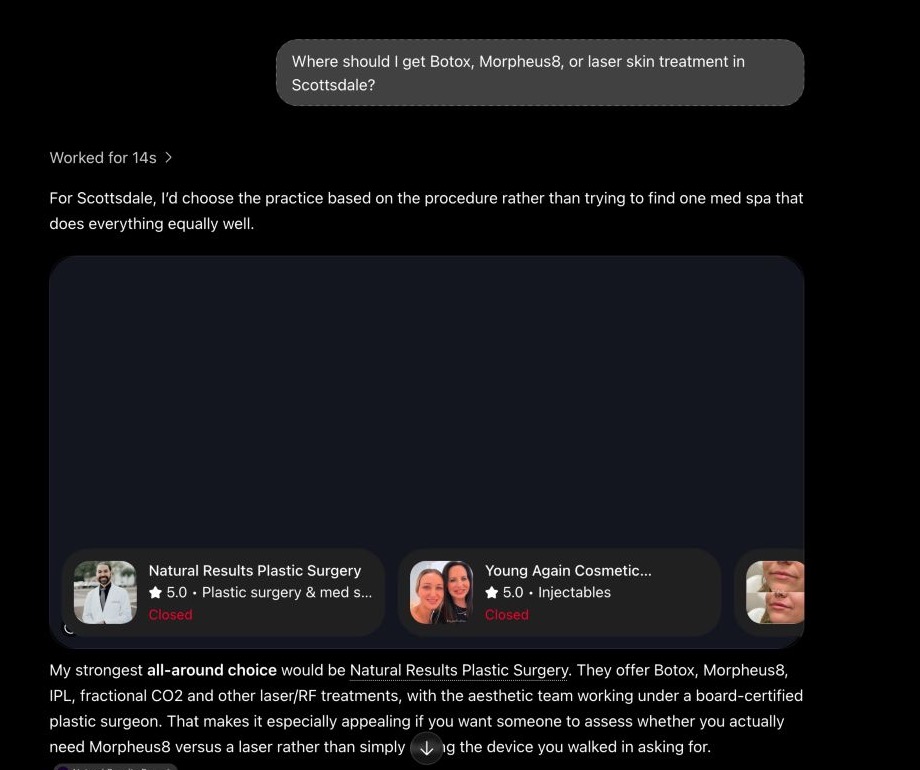
Example point-in-time evidence. The target clinic is absent and therefore not shown.
What happens after the snapshot
- You receive the report. You can use it without booking a call.
- You decide whether the gap matters. Some findings need a small internal fix. Others need ongoing work.
- You can book a call. We discuss the evidence and commercial priority.
- Serum scopes the next phase only if there is a fit. The proposal states the work, timing, clinic responsibilities, and measurement plan.
No paid work starts because someone filled out the free form. A clinic can skip the snapshot and book directly.
Limits of the snapshot
- It is a point-in-time test.
- Results can change with wording, location, platform, sources, or session context.
- An AI answer can contain mistakes.
- A technical issue may be relevant without being the sole cause of an omission.
- A clinic mention does not confirm clinical quality or treatment suitability.
Search Atlas showed zero recorded US monthly searches for the exact clinic-snapshot and med spa ChatGPT phrases on August 21, 2026. We still use these questions because they map to a real buying decision. This is a bottom-funnel method, not a traffic forecast.
For the broader implementation context, read the med spa SEO framework, the medical aesthetics marketing framework, or the patient-acquisition measurement guide.
Request your clinic snapshot
Send the clinic name, website, city, priority treatment, and work email. Do not include patient data or medical information.
Frequently asked questions
Is the clinic AI visibility snapshot free?
Yes. The initial snapshot described on this page is free. Any broader audit, implementation, or monitoring work is scoped separately.
Do you need access to our website or business profiles?
No account access is required for the free snapshot. Serum uses public information and its own research tools.
What information should we avoid submitting?
Do not submit patient names, health information, treatment records, private photos, passwords, or portal credentials.
Can I book a call without filling out the snapshot form?
Yes. Direct booking remains available for clinics that already know they want to discuss the work.
What if our clinic already appears in the three searches?
The report should say so. Serum will not manufacture a problem to justify more work.
Sources
- OpenAI: Searching the web with ChatGPT
- OpenAI: Overview of OpenAI Crawlers
- Google Search Central: AI features and your website
- Google Search Central: LocalBusiness structured data
- Microsoft Bing Webmaster Guidelines
- Schema.org: MedicalClinic
- Search Atlas Keyword Researcher, US database, checked August 21, 2026. Account access required.
This article covers marketing visibility. It doesn't provide medical, legal, privacy, or compliance advice.